
What is the E-commerce Business Model?
BUSINESS MODEL
Stackari
14 min read
Heads up: a few links are affiliate links, and some include special offers you won’t want to miss.
Ecommerce, short for electronic commerce, has transformed how people shop and businesses sell.
Today, instead of visiting physical stores, customers can browse products, compare options, make purchases, and receive support entirely online.
From clothing and electronics to services and digital goods, ecommerce enables transactions anytime, anywhere, using computers, tablets, or smartphones.
For businesses, it opens global markets, reduces overhead costs, and provides data-driven insights to improve customer experiences.

What is an Ecommerce Business Model?
An ecommerce business model is the strategy a company uses to sell products or services online and generate revenue. It defines who the business sells to, how transactions happen, and how the company makes money.
Common types include:
B2C (Business-to-Consumer):
Companies sell directly to individual customers, like Amazon or Zalora.B2B (Business-to-Business):
Businesses sell products or services to other businesses, such as Alibaba or Grainger.C2C (Consumer-to-Consumer):
Individuals sell to other individuals, usually via a platform like eBay or Facebook Marketplace.Subscription-Based:
Customers pay recurring fees for products or services, such as Netflix or Dollar Shave Club.Dropshipping:
The store sells products it doesn’t stock, and suppliers ship directly to customers.Marketplace Model:
The platform connects multiple sellers and buyers without owning inventory, earning revenue through commissions, listing fees, or subscriptions.
Essentially, an ecommerce business model explains how the business delivers value online, connects with customers, and earns revenue.


How the Ecommerce Model Works
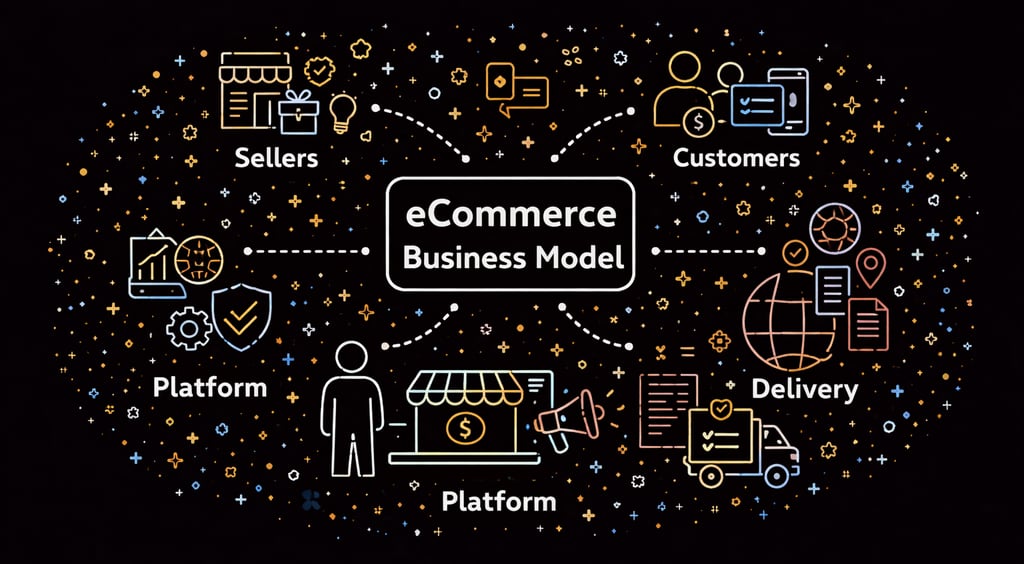
Running an ecommerce business is more than just setting up a website. True success depends on building systems that handle sales, inventory, fulfillment, marketing, and customer support efficiently. Here are the key components every founder should understand:
1. Product Selection and Inventory
Deciding what to sell is the foundation of any ecommerce business. Common options include:
Physical products: Items you manufacture, source, or wholesale.
Digital products: Downloads, software, or online courses.
Dropshipping: Products shipped directly from a supplier without holding inventory.
Custom or handmade items: Unique offerings tied to your brand.
Example: Gymshark started with a small line of fitness apparel sold online and scaled rapidly using social media marketing and influencer partnerships. Choosing the right products that match your audience is key to early traction.
2. Online Storefront
Your storefront is where customers browse, compare, and buy your products. Options include:
Dedicated websites: Shopify, WooCommerce, BigCommerce, Squarespace.
Marketplaces: Amazon, Etsy, eBay.
Social commerce platforms: Instagram Shop, Facebook Marketplace.
A clean, user-friendly interface with easy navigation, fast load times, and clear calls to action is critical for conversions and customer trust.
3. Payment Processing
Secure and seamless payments are essential for ecommerce success. Common options include:
Credit/debit cards
PayPal
Stripe
Apple Pay, Google Pay, and other digital wallets
Offering multiple payment options increases trust and reduces abandoned carts. Consider integrating fraud protection and recurring billing if you plan subscription products.
4. Fulfillment and Shipping
Orders need to reach customers quickly and reliably. Common fulfillment methods:
Self-fulfillment: Pack and ship orders in-house.
Dropshipping: Suppliers ship directly to customers.
Third-party logistics (3PL): Warehouses and fulfillment centers manage storage and delivery.
Example: Allbirds uses direct-to-consumer shipping to ensure quality control and maintain a consistent brand experience, even at scale. Efficient fulfillment can be a competitive advantage in ecommerce.
5. Marketing & Customer Acquisition
Driving traffic and converting visitors into buyers is crucial. Core strategies include:
SEO and content marketing to attract organic search traffic.
Social media campaigns, influencer marketing, and user-generated content.
Paid advertising through Google Ads, Facebook Ads, and retargeting.
Email campaigns for engagement, promotions, and cart recovery.
Example: Glossier grew largely through social media buzz, community engagement, and word-of-mouth, proving the power of storytelling and community in ecommerce.
6. Customer Support & Retention
Since online shoppers cannot physically inspect products, trust and support are vital:
Offer live chat, email, or phone support.
Provide hassle-free returns and refunds.
Use loyalty programs, subscriptions, or repeat-purchase incentives to retain customers.
Excellent support boosts repeat sales, positive reviews, and long-term brand loyalty, creating a foundation for sustainable growth.
An ecommerce business is a system, not just a storefront. Each component from product selection to fulfillment to marketing must work together efficiently to create a smooth experience for customers. The most successful ecommerce brands combine quality products, seamless operations, and strong customer engagement to build trust and scale globally.


Pros and Cons of the Freemium Model
Pros
1. Global Reach
Ecommerce removes geographical barriers. Businesses can sell to customers anywhere in the world without physical stores.
Example: Amazon sellers leverage the platform to reach millions of buyers globally, from North America to Asia, without opening a single local store.
2. Lower Startup Costs
Compared to traditional retail, ecommerce requires minimal upfront investment. Retail space, utility bills, and physical storefront expenses are eliminated.
Example: Entrepreneurs can launch a Shopify store for a few hundred dollars, using dropshipping to avoid purchasing inventory upfront.
3. Scalability
Automated systems for inventory, order processing, payments, and marketing allow ecommerce businesses to scale quickly.
Example: Gymshark started as a small Shopify store selling fitness apparel and scaled into a global brand with automated online sales and marketing systems.
4. Flexible Business Models
Ecommerce supports multiple monetization strategies: one-time product sales, recurring subscriptions, membership programs, digital downloads, or hybrid approaches.
Example: Brands like Dollar Shave Club combine ecommerce product sales with subscription boxes to create predictable recurring revenue.
5. Data-Driven Insights
Online businesses can track customer behavior, purchasing trends, and marketing performance in real-time to make informed decisions and optimize growth.
Example: Analytics tools like Google Analytics and Hotjar help store owners understand which products most popular and which marketing channels are drive conversions.
Challenges of Ecommerce
1. High Competition
Many ecommerce niches are saturated, making differentiation critical. Strong branding, customer experience, and unique products are essential to stand out.
Example: Apparel and electronics markets are highly competitive; brands like Allbirds succeed by emphasizing sustainability, comfort, and design.
2. Customer Acquisition Costs
Driving traffic often relies on paid ads, influencer partnerships, and promotions, which can be expensive. Ongoing investment is needed to maintain visibility and sales.
Example: Many small ecommerce stores spend thousands per month on Google Ads or Instagram campaigns to attract new buyers.
3. Logistics and Fulfillment Challenges
As sales volume grows, inventory management, shipping, returns, and customer support can become complex. Poor fulfillment can harm reputation and repeat business.
Example: During peak holiday seasons, even Amazon experiences shipping delays, showing how logistics can strain operations.
4. Dependence on Technology
Website downtime, payment failures, or cybersecurity issues directly affect revenue. Ensuring platform reliability, security, and uptime is critical.
Example: An ecommerce site that goes offline during a flash sale can lose thousands in potential revenue in just hours.
5. Customer Trust and Retention
Without physical interaction, building credibility and repeat purchases requires excellent product descriptions, reviews, guarantees, and responsive support.
Example: Brands like Zappos became successful by prioritizing customer service, free returns, and transparent policies, creating loyalty without storefronts.
Key takeaway
Ecommerce offers unmatched reach, low startup costs, and flexibility, but founders must be ready to compete fiercely, manage logistics efficiently, and invest in marketing and technology. Success comes from combining great products, strong customer experience, and data-driven decision-making to scale effectively.
Subscribe to our newsletter


Enjoy exclusive special deals available only to our subscribers.


Why Founders Often Choose Ecommerce Models
1. Control Over Brand
Ecommerce allows direct interaction with customers, giving founders full control over their brand experience. You can define everything from product presentation to packaging, customer service, and marketing messaging.
Example: Glossier built its brand by controlling every touchpoint from website aesthetics to social media interactions creating a loyal online community.
2. Fast Testing & Iteration
Unlike brick-and-mortar stores, ecommerce allows rapid experimentation. You can test new products, pricing, or marketing strategies and adjust almost instantly based on customer feedback and sales data.
Example: Gymshark tested multiple designs and marketing campaigns on social media before scaling winning products, enabling rapid iteration with minimal financial risk.
3. Asset Value
An established ecommerce store is a sellable asset. Websites with traffic, subscribers, and historical sales data can be acquired or sold like a business, providing potential exit opportunities for founders.
Example: Many Shopify store owners sell profitable ecommerce stores on marketplaces like Exchange Marketplace, sometimes for multiples of annual revenue.
4. Hybrid Revenue Opportunities
Ecommerce isn’t limited to one product type or revenue stream. Businesses can combine:
Physical products
Digital downloads or courses
Subscription boxes or memberships
Affiliate or advertising revenue
This flexibility allows founders to diversify income and test different business models under the same ecommerce infrastructure.
Example: Dollar Shave Club started with physical products but added subscription services and upsells, creating predictable recurring revenue alongside one-time sales.
Founders choose ecommerce because it reduces upfront risk, allows rapid learning, and builds a scalable, brand-driven business. By combining physical, digital, and subscription offerings, ecommerce can generate multiple revenue streams while maintaining flexibility and control.


How to Validate if a Freemium Model Fits Your Business
Before investing heavily in inventory, software, or marketing, it’s essential to test your ecommerce idea. Early validation reduces risk, helps you understand your audience, and ensures your business has real demand. Here’s a step-by-step guide:
1. Conduct Market Research
Start by analyzing the market and understanding if there’s a genuine need for your product:
Search trends: Use tools like Google Trends to see how interest in your product category changes over time.
Competitor analysis: Study existing stores or brands. What are their prices, product offerings, and marketing strategies?
Social media insights: Explore discussions, hashtags, and communities to gauge customer interest.
Example: A founder considering eco-friendly water bottles might notice high engagement in sustainability-focused Instagram groups, signaling potential demand.
2. Launch a Minimum Viable Product (MVP)
An MVP lets you test demand without investing heavily:
Offer a limited product range to reduce complexity.
Use dropshipping or small batch production to avoid holding large inventory.
Focus on core features: product listings, checkout, and order fulfillment.
Example: Gymshark started with a few fitness apparel items online and scaled gradually, validating products and designs with early customers before expanding.
3. Create a Landing Page or Pre-Orders
You don’t need a full ecommerce store to measure interest:
Build a simple landing page explaining your product.
Use email capture forms or waitlists to collect potential buyers.
Offer pre-orders or early-bird discounts to test willingness to purchase.
Example: Many direct-to-consumer (DTC) brands test a new product line with pre-orders to confirm real demand before committing to manufacturing.
4. Run Small Test Ad Campaigns
Paid ads provide quick feedback on market interest:
Use social media platforms (Instagram, Facebook, TikTok) or search engines (Google Ads).
Test different messaging, visuals, and offers.
Track metrics like click-through rates, conversions, and cost per acquisition.
Example: A startup selling smart home devices might spend $100–200 on a targeted Facebook campaign to see how many people sign up or place pre-orders before scaling marketing spend.
5. Collect Feedback & Analyze Metrics
Data and customer input are crucial for refining your offering:
Monitor engagement: email sign-ups, comments, and inquiries.
Track conversions: how many visitors actually purchase or pre-order.
Gather qualitative feedback: surveys, reviews, or direct messages to understand preferences, pain points, and objections.
Example: A beauty brand could adjust packaging, product descriptions, or pricing based on early customer feedback, improving both satisfaction and repeat purchases.
Key takeaway
Validating an ecommerce idea doesn’t require a full launch or large inventory. By combining market research, MVP testing, landing pages, small ad campaigns, and feedback analysis, founders can:
Determine real demand
Refine their product and marketing approach
Reduce risk before scaling operations
Early validation ensures that when you do launch fully, you’re entering a market with proven interest, increasing your chances of success.
Tools and Platforms to Start an Ecommerce Business
Running an ecommerce business efficiently requires the right combination of platforms and tools. From managing your store to marketing, analytics, and fulfillment, these resources help founders save time, reduce errors, and scale faster
1. Ecommerce Platforms
Your choice of platform determines your store’s functionality, customization, and scalability:
Shopify: A complete ecommerce solution ideal for beginners and fast-growing stores. Offers apps for marketing, inventory management, and dropshipping.
WooCommerce: A flexible WordPress plugin for businesses that want full control over their site, design, and integrations.
BigCommerce: Enterprise-level features for scaling businesses, including multi-channel selling and advanced analytics.
Tip: Pick a platform based on your technical comfort, growth plans, and integration needs.
2. Payment Processing
Seamless, secure payments build trust and enable smooth transactions:
Stripe: Supports credit/debit cards, subscriptions, and split payments for marketplaces.
PayPal: Widely trusted and familiar to buyers worldwide.
Square: Ideal for both online and in-person sales, including POS integration.
Pro Tip: Offer multiple payment options to reduce abandoned carts and increase conversions.
3. Logistics & Inventory
Efficient order fulfillment is critical for customer satisfaction:
ShipStation, ShipBob: Automate shipping, print labels, and track orders. Ideal for scaling operations.
Oberlo (Shopify integration): Facilitates dropshipping, letting you sell products without holding inventory.
Inventory management tools: Tools like TradeGecko or Zoho Inventory help track stock levels, forecast demand, and prevent stockouts.
Example: Businesses using 3PL services like ShipBob can focus on marketing and growth while leaving fulfillment to experts.
4. Marketing & Analytics
Driving traffic and conversions requires data-driven campaigns:
Google Analytics: Understand customer behavior, track sales, and optimize your website.
Klaviyo: Email marketing automation for abandoned carts, promotions, and personalized campaigns.
Hootsuite or Buffer: Schedule and manage social media posts efficiently.
Paid Ads: Facebook Ads, TikTok Ads, and Google Ads allow precise targeting for customer acquisition and retargeting.
Pro Tip: Combine organic marketing (SEO, content) with paid campaigns for long-term and scalable growth.
5. AI and Content Tools
AI tools help save time and improve content quality:
ChatGPT, Jasper, Notion AI: Generate product descriptions, ad copy, email campaigns, and social media content.
Canva AI: Quickly create visuals for product listings, ads, and marketing materials.
Example: A small ecommerce brand can generate 50+ product descriptions in minutes with AI, allowing more time for marketing strategy and customer engagement.
While tools make ecommerce easier, success depends on how well you integrate and use them. Automating repetitive tasks, tracking analytics, and maintaining smooth fulfillment ensures your store is scalable, efficient, and customer friendly.


How to Start an Ecommerce Business (Step-by-Step)
Launching an ecommerce business successfully requires more than setting up a website. You need systems for sales, fulfillment, marketing, and customer support, combined with ongoing testing and optimization. Follow these six practical steps:
Step 1: Decide Your Niche and Product
Research the market: Identify gaps, trends, and customer pain points using tools like Google Trends, Amazon Best Sellers, and social media insights.
Choose your product type: Options include:
Physical products: Manufactured or sourced items
Digital products: Downloads, software, or online courses
Hybrid: A mix of physical and digital offerings
Example: Gymshark started with fitness apparel targeting a niche online audience, growing quickly via social media marketing and influencer partnerships.
Common mistake to avoid: Picking a niche based solely on passion without market demand. Validate interest first.
Step 2: Build Your Online Store
Pick the right platform: Shopify, WooCommerce, BigCommerce, or a marketplace like Amazon or Etsy.
Design for conversion: Ensure product pages have high-quality images, clear descriptions, pricing, and call-to-action buttons.
Simplify checkout: Offer multiple payment options and guest checkout to reduce abandoned carts.
Pro tip: Mobile-first design is essential since most ecommerce traffic comes from smartphones.
Step 3: Set Up Payments and Shipping
Secure payment gateways: Use Stripe, PayPal, Square, Apple Pay, or Google Pay.
Choose a fulfillment strategy:
Self-fulfillment: Handle packing and shipping yourself
Dropshipping: Supplier ships directly to customers
Third-party logistics (3PL): Outsourced warehouses manage storage and shipping
Example: Allbirds manages direct-to-consumer shipping to maintain brand experience and quality.
Tip: Communicate shipping timelines clearly and offer tracking to increase customer trust.
Step 4: Launch Marketing and Customer Acquisition
Drive traffic: Use social media, influencer campaigns, email marketing, SEO, and paid ads (Facebook, TikTok, Google).
Test and optimize: Start with small campaigns, measure clicks, conversion rates, and adjust accordingly.
Example: Glossier leveraged community engagement and social buzz to rapidly grow a loyal customer base.
Tip: Focus on storytelling and creating a brand community, not just selling products.
Step 5: Track Metrics
Key metrics to monitor:
Sales and revenue
Average order value (AOV)
Customer acquisition cost (CAC)
Return rates and refunds
Customer lifetime value (LTV)
Action: Use insights to refine pricing, product offerings, marketing, and fulfillment.
Tools to consider: Google Analytics, Shopify Analytics, Klaviyo for email, and Hotjar for user behavior insights.
Step 6: Scale Your Business
Expand product lines or variations to increase AOV
Enter new markets or regions based on demand
Launch additional sales channels: Amazon, Etsy, or social commerce platforms
Automate operations: Use tools like ShipBob, Oberlo, and Zapier to reduce manual work
Tip: Scale only when your customer support, fulfillment, and marketing systems can handle growth.
Starting lean and validating each step is crucial. Ecommerce success comes from:
Testing products and markets before large investments
Building seamless systems for payments, fulfillment, and marketing
Prioritizing customer experience to drive trust and repeat business
By following these steps, founders can launch efficiently, optimize continuously, and scale sustainably.
Conclusion
The ecommerce model allows businesses to reach a global audience with minimal physical infrastructure. It is highly flexible, scalable, and can combine multiple revenue streams. Success requires careful product selection, strong marketing, operational efficiency, and ongoing customer engagement. Whether selling physical goods, digital products, or hybrid solutions, ecommerce can be a powerful, profitable, and manageable business model.
Subscribe to our newsletter
Enjoy exclusive special deals available only to our subscribers.
FAQ
1. What is an ecommerce business model?
An ecommerce business model defines how a company sells products or services online, including how it sources products, markets them, processes payments, and delivers orders to customers.
2. What are the main types of ecommerce models?
The most common models include B2C (business to consumer), B2B (business to business), C2C (consumer to consumer), and DTC (direct to consumer). Each model differs in target customers, pricing, and operations.
3. How much does it cost to start an ecommerce business?
Startup costs vary widely. A basic store can launch with a few hundred dollars, while more advanced operations may require thousands for inventory, branding, marketing, and software tools.
4. Do I need to hold inventory to run an ecommerce store?
No. Some models like drop shipping and print on demand allow you to sell products without holding inventory, while others require purchasing and storing stock upfront.
5. What is the difference between drop shipping and holding inventory?
Drop shipping shifts fulfillment to a supplier after a sale is made, reducing upfront risk. Holding inventory gives you more control over quality, shipping speed, and margins but requires higher capital.
6. Which ecommerce platform is best for beginners?
Popular beginner friendly platforms include Shopify, WooCommerce, and Wix. The best choice depends on budget, technical skills, and how much customization is needed.
7. How do ecommerce businesses make money?
Revenue comes from selling products or services online. Profit depends on pricing, cost of goods, marketing efficiency, and operational expenses such as software and fulfillment.
8. What payment methods should an ecommerce store support?
Most stores accept credit and debit cards, digital wallets like PayPal or Apple Pay, and regional payment options to reduce checkout friction and increase conversions.
9. How do ecommerce businesses handle shipping and fulfillment?
Shipping can be managed in house, outsourced to third party logistics providers, or handled by suppliers in drop shipping models. The method chosen affects speed, cost, and customer experience.
10. How long does it take for an ecommerce store to become profitable?
Profitability timelines vary. Some stores see profits within months, while others take a year or more depending on niche, marketing strategy, and operational efficiency.
11. What are the biggest challenges in ecommerce?
Common challenges include customer acquisition costs, competition, logistics complexity, returns management, and maintaining consistent product quality.
12. How important is marketing for an ecommerce business?
Marketing is critical. Traffic does not happen automatically, so ecommerce businesses rely on SEO, paid ads, social media, email marketing, and content to drive sales.
13. Can ecommerce businesses scale globally?
Yes. Ecommerce allows businesses to sell internationally, but scaling globally requires planning for shipping costs, taxes, regulations, and local payment preferences.
14. What legal requirements do ecommerce businesses need to follow?
Requirements may include business registration, tax compliance, consumer protection laws, privacy policies, and payment security standards depending on location.
15. How do I know if my ecommerce idea has real demand?
Demand can be validated through market research, keyword analysis, competitor reviews, social media trends, and small test launches before scaling.
View other AI Tools to start your Subscription Business
If you’d like to dive deeper into how different business models work, explore the other sub-guides in this series:
Subscription Model: How free users convert into long-term revenue
Marketplace Model: How platforms earn by connecting buyers and sellers
Saas Model: Models built for scalable, low-risk expansion
Each guide includes real examples, advantages, challenges, and step-by-step insights to help you choose the best model for your product idea and growth goals.


Business Calculator
View Our handy business calculators! While we make more...
Subscribe to our newsletter
Enjoy exclusive special deals available only to our subscribers.


This blog made everything about passive income so much easier to grasp. The way it’s written is super clear and beginner-friendly.
Clarice Turner


I’ve always heard about passive income, but I never really understood how it worked—until I read this blog.
Brian Moten

★★★★★
★★★★★
Contacts
stackari.contact@gmail.com